


What Is the Philosophy of Digital Growth & Why It Changes Everything

Updated: May 10
Most businesses treating digital growth as a spending problem are asking the wrong question. They add another tool, hire another freelancer, run another ad campaign, and still wonder why the results don't match the investment. The real issue isn't the budget. It isn't the platform. It isn't even the content. The issue is how they think about growth in the first place.
That's what the philosophy of digital growth is built to address. Not another framework to follow blindly. Not a checklist to tick off. A genuine shift in how you see, approach, and build your digital presence, one that makes every strategy sharper and every execution more intentional.
If you've ever felt like you're doing all the right things digitally but still not moving forward the way you should be, this is the piece you've been waiting for.
Digital Growth Is Not What Most People Think It Is
Ask ten business owners what digital growth means and you'll get ten different answers. More followers. More website traffic. More leads. More sales. All of those things matter, but none of them are digital growth. They're outcomes. And chasing outcomes without understanding the thinking behind them is exactly why so many businesses stay stuck.
Why More Tactics Rarely Produce More Growth?
The instinct, when results plateau, is to do more. Post more often. Run more ads. Try more platforms. It feels productive. It looks like action. But activity and growth are not the same thing, and confusing the two is one of the most expensive mistakes a business can make.

When you stack more tactics on a weak foundation, you amplify what's already misaligned. If your messaging isn't clear, more posts just spread the confusion further. If your offer isn't positioned well, more traffic just means more people leaving your site without converting. More is not the answer when the strategy underneath needs work.
The Difference Between Digital Marketing and Digital Growth
Digital activity is what you can measure by the hour. Posts published, emails sent, ads launched, clicks recorded. Digital growth is what you measure by the quarter, and more importantly, by the direction things are moving. Are you building an audience that trusts you? Are you creating content that attracts the right people? Are you converting attention into actual business results?
As Simon Sinek puts it, "People don't buy what you do; they buy why you do it." That principle applies just as directly to digital marketing. The brands that grow aren't the ones doing the most. They're the ones who are clearest on their purpose and most consistent in expressing it.
What the Philosophy of Digital Growth Actually Means?
The philosophy of digital growth is the belief that how you think about your digital presence determines how you build it, and ultimately, how far it takes you. It's the understanding that mindset comes before strategy, strategy comes before execution, and skipping any layer in that sequence costs you time, money, and momentum.
It's not about rejecting tools or tactics. It's about knowing exactly why you're using them, who they're for, and what they're designed to do. When you have that clarity, every decision becomes faster and smarter. When you don't, every decision is a guess.
Why the Philosophy of Digital Growth Starts With Mindset?
This is the part most marketing advice skips, because it's harder to sell a mindset shift than a software subscription. But after almost 20 years of working with businesses across industries, I can tell you with certainty: the companies that grow digitally and sustain that growth all share one thing. They think differently before they act differently.
The Three Layers: Mindset, Strategy, Execution
The Digital Growth Evolution Framework is built on three layers that must be developed in sequence. Mindset is the foundation. Strategy is what you build on top of it. Execution is what you do with both.
Mindset means understanding your brand, your audience, your positioning, and your genuine value before you write a single piece of content or spend a single euro on advertising. It means being honest about where you are, where you want to go, and what you actually believe about the value you offer.
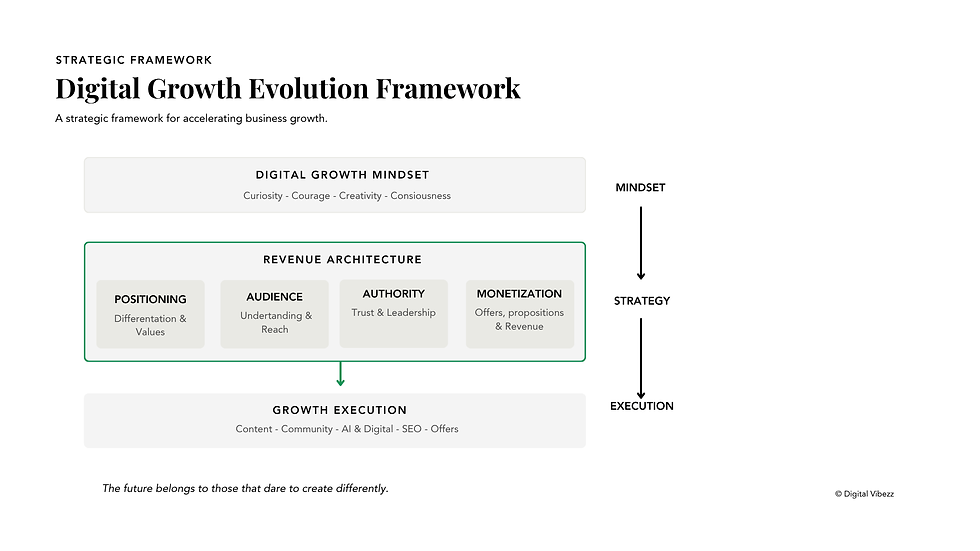
Strategy means translating that clarity into a plan. Which channels make sense for your audience? What kind of content builds trust with them? What does the customer journey look like from first touch to loyal client? These questions can only be answered well when the mindset layer is already solid.
Execution is where most businesses start, and why so many get stuck. They launch campaigns without a strategy. They build strategies without a clear mindset. And then they blame the platform when the results don't come.
What Happens When You Skip the First Layer
I worked with a founder who had invested heavily in a full content calendar, a professional video setup, and a paid social budget that most small businesses would consider significant. Six months in, she had great-looking content and almost no return. When we sat down to look at why, the answer was clear within twenty minutes. She had never defined who she was specifically talking to. Her content was speaking to everyone, which meant it was connecting with no one.
We went back to the mindset layer. We defined her audience precisely, clarified her positioning, and rebuilt her content strategy from there. Within eight weeks, her engagement had tripled and she had signed two new clients directly from her organic content. Nothing about the execution changed dramatically. The thinking did.
How Mindset Shapes Every Digital Decision You Make
Every digital decision, what to post, where to show up, how to price, how to pitch, is downstream of how you think about your brand and your audience. A business with a clear, confident mindset makes those decisions quickly and consistently. A business without that clarity second-guesses everything, chases trends, and ends up with a digital presence that feels scattered because it is.
As Seth Godin writes in This Is Marketing, "The goal isn't to do more. The goal is to do the right things for the right people." The philosophy of digital growth is, at its core, exactly that commitment applied to every layer of your digital presence.
The Three Principles That Drive Sustainable Digital Growth
Once the mindset is clear, the philosophy of digital growth works through three core principles. These aren't stages to complete and move on from. They're ongoing commitments that reinforce each other and compound over time.
Visibility: Being Found by the Right People at the Right Time
Visibility is not about being everywhere. It's about being exactly where your ideal audience looks, at the moment they're ready to pay attention. That means understanding which platforms your audience actually uses, what they search for, what kind of content earns their attention, and how your brand shows up in those spaces.
A well-built digital growth strategy always starts with visibility, not because it's the most exciting part, but because nothing else works without it. You can have the best offer in your category and still lose to a competitor with a weaker product and stronger visibility. Getting found is non-negotiable.
Visibility is also where SEO, content marketing, and social media converge. According to McKinsey research on digital growth and content strategy, businesses that build systematic visibility through owned content significantly outperform those relying exclusively on paid channels for discovery. Owned visibility compounds. Paid visibility stops the moment you stop paying.
Trust: Turning Attention Into Genuine Belief
Getting found is the beginning. What happens next is where most businesses lose ground. Someone finds your website, lands on your Instagram, reads your LinkedIn profile, and feels nothing. No connection. No confidence. No reason to take the next step.
Trust is built through consistency, specificity, and genuine value. It's built when your content actually helps people rather than just promoting your services. It's built when your brand voice sounds like a real person who knows what they're talking about, not a corporate announcement. It's built, and this matters, when what you say matches what you do.
Understanding the balance between authenticity and results is one of the most commercially important decisions a brand can make. You can read more about how to get that balance right in this piece on balancing authenticity with digital growth. Audiences in 2026 are sophisticated. They know when they're being sold to, and they respond to honesty far more than polish.
Value: Making Every Interaction Worth Something
The third principle is value, and it means something more specific than "good content." Value is what the reader, viewer, or visitor walks away with after every interaction with your brand. The insight they gained, the problem they solved, the idea they hadn't considered before.
When every piece of content you produce, every email you send, every social post you publish delivers genuine value to the right person, something shifts. You stop competing on volume and start competing on quality. You stop chasing algorithms and start building an audience that comes back, shares, and refers.
As Gary Vaynerchuk has said consistently across years of talking about content and brand building, "Give value. Give value. Give value. Then ask." The brands that understand this and mean it are the ones that grow sustainably. According to Harvard Business Review research on content-led growth, companies that lead with genuine audience value generate significantly higher long-term customer retention than those that lead with promotional messaging.
How the Philosophy of Digital Growth Changes the Way You Build
Adopting this philosophy doesn't mean starting over. It means looking at everything you're already doing through a sharper lens and making decisions that are more intentional, more strategic, and more likely to compound over time.
From Reactive to Intentional
Reactive digital marketing is what most businesses do by default. Something trends, they jump on it. A competitor launches something new, they scramble to respond. A platform changes its algorithm, they panic and rebuild everything. Reactive marketing exhausts teams, dilutes brand identity, and produces inconsistent results that are nearly impossible to learn from.
Intentional digital marketing is built from the inside out. You know your audience, your positioning, and your goals. You know why you're on each platform and what you're there to achieve. When trends come and go, and they always do, you can evaluate them clearly rather than chasing them blindly. You decide what fits your strategy. You decide what doesn't. That clarity is what produces consistency, and consistency is what produces growth.
From Chasing Trends to Building Momentum
Trends are useful signals. They tell you what's working for others right now, what audiences are responding to, and where attention is shifting. But they are not a strategy. Businesses that build their entire digital presence around trends find themselves constantly restarting, because each new trend requires a new approach, a new format, a new voice.
Momentum, on the other hand, builds on itself. When you create content consistently around your core philosophy, when you show up for the same audience with the same values week after week, you accumulate authority. Your audience grows because existing followers bring new ones. Your content performs better because the algorithm recognises consistent engagement. Your brand becomes the reference point in your space rather than another voice trying to catch up.
What This Looks Like in Practice
A business living the philosophy of digital growth doesn't post more. It posts with more purpose. It doesn't chase every new platform. It goes deep on the right ones. It doesn't measure success by vanity metrics. It tracks the numbers that actually connect to business outcomes: leads generated, clients acquired, revenue attributed to digital channels.
It also looks like a team asking different questions before launching anything. Not "what should we post this week?" but "what does our audience need right now, and how can we deliver it better than anyone else?" Not "how do we get more followers?" but "how do we build a community that trusts us enough to buy?"
Where Do You Start With the Philosophy of Digital Growth?
Here's the honest answer: you start by assessing where you actually are, not where you hope you are or where you think you should be. Most businesses find, when they look clearly, that they're operating heavily in the execution layer with significant gaps in strategy and almost no conscious work done at the mindset level. That's not a failure. It's simply where the work begins.
The Digital Growth Evolution framework exists to help you move through all three layers deliberately, building the mindset, designing the strategy, then executing with the focus and consistency that produces real results. It's the structured path from where you are to where your digital presence has the potential to take you.
If you're ready to stop guessing and start building with intention, explore the Digital Growth Evolution and find out exactly where your business stands right now. The shift starts with how you think, and that shift starts here.
Questions about the Digital Growth Philosophy
What is the philosophy of digital growth?
It's the belief that real digital growth starts with how you think, not which tools you use. Mindset first, strategy second, execution third. Skip the first layer and everything else costs you more than it should.
How is the philosophy of digital growth different from regular digital marketing?
Regular digital marketing starts at execution. This philosophy starts with the thinking behind it. It asks why before it asks how, which changes the quality of every decision that follows.
Why does digital growth start with mindset?
Because mindset shapes strategy, and strategy shapes execution. When you know exactly who you're talking to and what value you deliver, every digital decision becomes faster and clearer. Without that, even the right tools produce inconsistent results.
What are the three principles of the philosophy of digital growth?
Visibility, Trust, and Value. Be found by the right people, turn that attention into belief, and make every interaction worth something real. Together, they create growth that sustains itself.
How does the digital growth evolution framework connect to this philosophy?
The Digital Growth Evolution is the practical application of the philosophy. It maps mindset, strategy, and execution into a clear, actionable journey so businesses can build in the right sequence rather than jumping straight to tactics.
Can small businesses apply the philosophy of digital growth?
Absolutely. When resources are limited, clarity is everything. This philosophy helps SMBs focus energy where it produces the highest return instead of spreading thin across every platform and trend.
How do I know if my business is ready to apply the philosophy of digital growth?
If you're investing in digital marketing and not seeing results that match that investment, you're ready. Start with the Digital Growth Audit to find out exactly where you stand and what to focus on first.




Comments